What to Expect during a C-Section


What is a c-section?
A C-sectionSometimes called a C-Section, this is a surgery where incisions (cuts) are made first into the abdomen, and then the layers of the uterus. From there, the baby and the umbilical cord and placenta are removed. , also called a cesarean section, or cesarean delivery, is the surgical delivery of the baby through incisionsA cut through the skin and tissue that is needed to perform surgery. Not every surgery requires an incision. The opening is usually "closed up" with stitches or staples after the surgery. (cuts) made in the lower abdomenSometimes called the “belly” or “core,” this is the part of the body below the chest and above the pelvis. and uterusCommonly called the “womb,” this is a muscular organ in the female reproductive system that is responsible for menstruation (the period), growth and development of a pregnancy, and the delivery a baby. . Sometimes a C-section is planned before labor begins because it’s the safest way to deliver your baby. Other times, a C-section becomes necessary during labor if you or your baby’s safety are at risk.
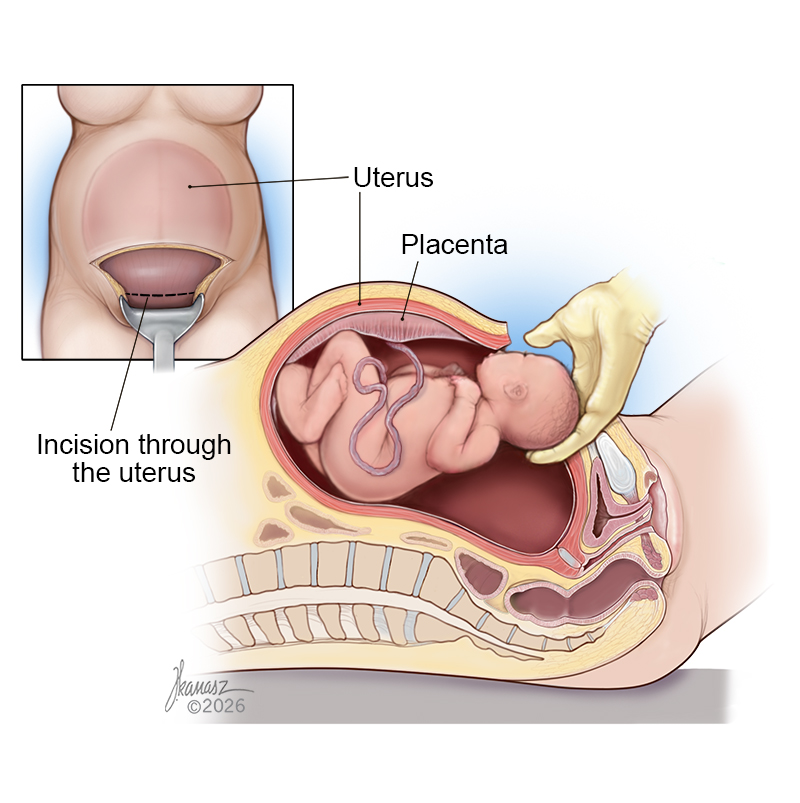
This illustrates the process of a baby being born via c-section.
When is a C-Section needed?
Your doctor may recommend a C-section if:
- You or your baby are not tolerating labor well
- Labor is not progressing as expected
- Learn more about how labor progresses.
- There are other medical reasons that make a C-section the safest choice for you and your baby such as:
- Your baby being in a potentially unsafe position, such as breech positionThe baby is positioned feet first in the uterus instead of head-first. Most babies in this position are born via c-section since this is the safest option.
- Worsening preeclampsiaA serious complication of pregnancy that can lead to very high blood pressure and protein in the urine. If left untreated, this can lead to seizures (eclampsia).
- Umbilical cordA flexible, rope-like structure that connects the developing fetus to the placenta. This allows the baby to receive oxygen and nutrients and remove waste products. is tightly wrapped around your baby’s neck (nuchal cordA common situation where the umbilical cord is wrapped around the baby’s neck. This can usually be easily resolved during delivery. In rare cases, this can be an emergency if the cord is wrapped too tightly around the baby’s neck. ) or slips into birth canal (umbilical cord prolapseAn emergency situation where the umbilical cord slips into the birth canal before the baby. This leads to cord compression and can result in the baby not receiving enough blood and oxygen. )
- PlacentaAn organ that develops during pregnancy that allows the developing fetus to receive oxygen and nutrients and remove waste products. The placenta develops inside of the uterus and connects to the fetus through the umbilical cord. separates from inside of uterus, resulting in severe bleeding and decreased oxygen to your baby
What type of anesthesia is used for a C-section?
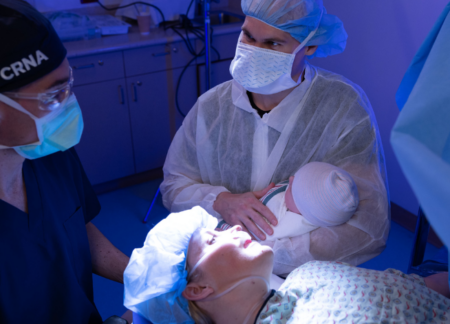
Most C-sections use either an epiduralAn injection of numbing medication into the epidural space that blocks pian signals from specific nerves. Epidurals can be given as a single injection, or with a catheter (tubing) that stays in place to continuously give medication. or a spinalSometimes called a “spinal block,” this is an injection of numbing medication into the spinal fluid that numbs the body from the waist down. for anesthesiaThe use of medications to temporarily block pain, sensations, and awareness during procedures and surgery. There are many different types of anesthesia that a CRNA can provide. . These allow you to stay awake during the delivery of your baby while your lower body is numb, so you won’t feel pain. If there is not enough time to place an epidural or spinal, or if there are other medical reasons, your anesthesia professional, such as a Certified Registered Nurse Anesthetist (CRNA)Sometimes called a CRNA, nurse anesthesiologist, or nurse anesthetist, these are advanced practice registered nurses (APRN) who specialize in administering anesthesia for surgical, diagnostic, and therapeutic procedures. , may use general anesthesiaA state of unconsciousness that is caused by medications administered by an anesthesia professional. This form of anesthesia is often used for procedures that would be too painful or uncomfortable to perform while the patient is only sedated or awake.. You may also hear CRNAs called nurse anesthesiologists or nurse anesthetists. General anesthesia means you will be asleep during the delivery. You will wake up in the recovery roomThis is where you will recover from anesthesia immediately after your surgery. after your baby is born. Learn more about Anesthesia Options during Labor.
What can I expect if I’m having a C-section?
Before the surgery your anesthesia professional will:
- Review your medical history and pregnancy
- Discuss the risks and benefits of your anesthesia options
- Answer all your questions
- Have you sign a consent form (in a true emergency, verbal consent may be the quickest option)
During the procedure:
- Monitors will be placed to track your heart rate, blood pressure, oxygen levels, and breathing
- You will be positioned on your side or sitting up with your lower back pushed out (resembling a cooked shrimp or a scaredy-cat) to receive your epidural or spinal anesthesia. Learn more about Local and Regional Anesthesia.
- Your baby’s heart rate will continue to be monitored throughout this process
- Your back will be cleaned with a sterileFree from microorganisms such as bacteria, viruses, parasites, and fungi solution
- Numbing medication will be given with a small needle
- Your anesthesia professional will place the epidural catheter or spinal needle
- You will be asked to lie down flat
- Your vital signs (such as heart rate, blood pressure, oxygen levels, and breathing) will be checked frequently
- Your baby’s condition will be monitored throughout this process
What can I expect if I need an emergency c-section?
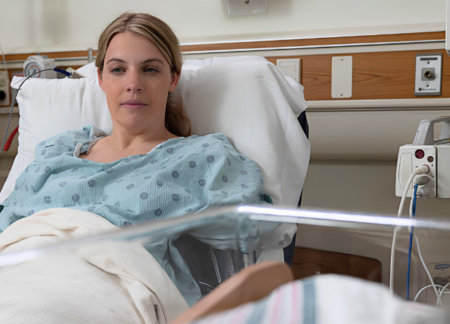
During an emergency C-section, your care team will act quickly to deliver your baby as safely as possible. In an emergency, your anesthesia professional will try to use an epidural or spinal if there is time. If there is not enough time, general anesthesia may be necessary. It’s very important to stay as calm as possible and follow your obstetric team’sThe healthcare professionals who specialize in pregnancy, childbirth, and the baby during labor. instructions. Taking slow, controlled deep breaths will help you and your baby. After the C-section, you will wake up in the recovery room and be told what happened.
Whether you’re delivering your baby vaginally or via C-section, your anesthesia professional is there to help manage your pain, keep you and your baby safe, and provide emergency support if needed. Learn about What to Expect after a C-Section and Anesthesia Safety during Labor and Delivery.
Disclaimer: The information on this page is for general educational and informational purposes only and does not constitute medical advice or a recommendation for any specific anesthesia technique, drug, or treatment. Users should consult a qualified medical professional before making any decisions regarding anesthesia care. For complete terms, see our Terms of Use.






Was this helpful?