Spinal and epidural anesthesia are safe and effective ways to provide pain relief during childbirth, surgery, or other procedures. This resource discusses the safety of spinal and epidural anesthesia. Download and print this resource from our experts in anesthesia care.
Anesthesia Options during Labor
Understanding how your pain can be prevented and managed throughout labor and delivery.
Written and Reviewed on May 25, 2026 by Thomas Winn, DNP, CRNA, CNE

Article Summary
There are different ways to manage pain during labor and delivery. Your anesthesia professional, such as a Certified Registered Nurse Anesthetist (CRNA), will help you choose the option that is best for you and your baby. Every patient is different, and there is no one-size-fits-all approach. This article reviews the different anesthesia options that are available to you during labor to help manage pain and keep you comfortable.

Epidural anesthesia
An epiduralAn injection of numbing medication into the epidural space that blocks pian signals from specific nerves. Epidurals can be given as a single injection, or with a catheter (tubing) that stays in place to continuously give medication. is a common way to manage pain during labor and deliveryThe process of childbirth where the body prepares for birth (labor) through uterine contractions and cervical dilation (opening) and the baby is born (delivery). . An epidural involves placing a small plastic catheter (tubing) through a needle into the epidural space (a cushioned, fatty “tunnel” that surrounds the sac containing your spinal cordA tube of nervous tissue that runs from the base of the brain down to the end of the spine. The spinal cord is responsible for sending nerve signals from the brain to the rest of the body. and nerves). The needle is removed, but the catheter stays in place. Through the epidural catheter, your anesthesiaThe use of medications to temporarily block pain, sensations, and awareness during procedures and surgery. There are many different types of anesthesia that a CRNA can provide. professional, such as a Certified Registered Nurse Anesthetist (CRNA)Sometimes called a CRNA, nurse anesthesiologist, or nurse anesthetist, these are advanced practice registered nurses (APRN) who specialize in administering anesthesia for surgical, diagnostic, and therapeutic procedures. , gives you localA type of anesthesia that numbs a smaller area of the body with numbing medication. anesthesia medications (like those used at the dentist) and pain-relieving medications such as morphine and fentanyl. You may also hear CRNAs called nurse anesthesiologists or nurse anesthetists. The medications given during an epidural cause temporary numbness from where the epidural is placed down to your toes.
Placement:
- You will need to sit on the side of the bed and curve your lower back (like a “cooked shrimp” or “scaredy cat”).
- This position can be difficult as labor progresses, so it’s important to tell your anesthesia professional if you’re having trouble staying still.
- If you’re planning a natural delivery without an epidural, remember that there may come a point when you can’t sit still anymore, and an epidural may not be possible.
During labor:
- A weaker version of the medication allows you to move your legs while still having pain control.
- As your contractions become stronger and more frequent, the medication can be adjusted to give you more relief.
- You can press a button to give yourself a dose of medication when you need it (this is called patient-controlled analgesia or PCA).
After delivery:
- Your epidural may stay in for a short time after delivery.
- When it’s removed, your anesthesia professional may place a long-acting pain medication called Duramorph® that provides partial pain relief for about 12 hours or more.
- If you’re allergic to morphine, make sure to tell your anesthesia professional.
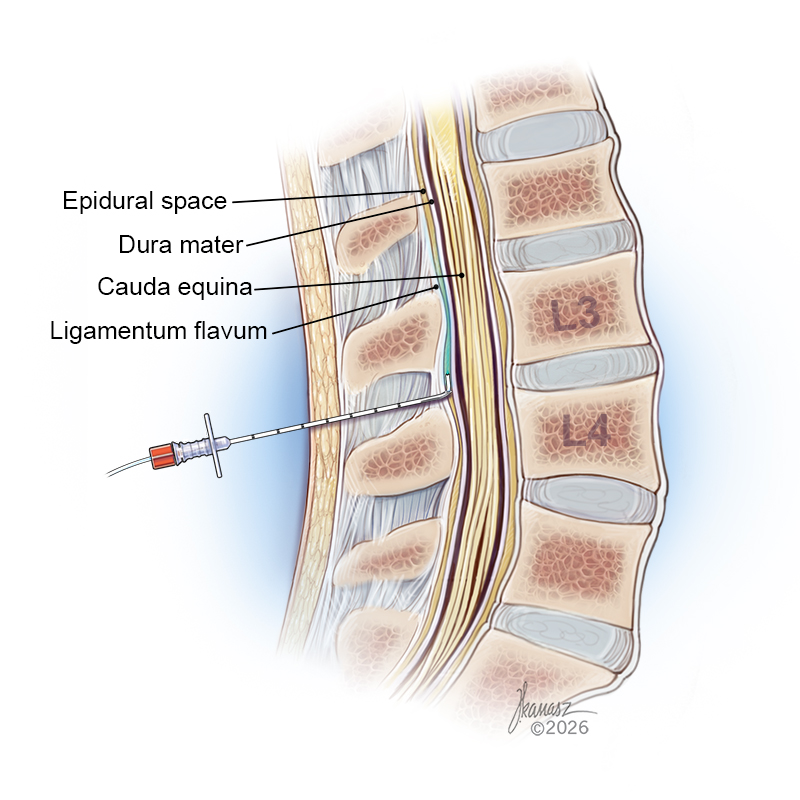
This diagram illustrates an epidural catheter that is inserted into the epidural space.
Spinal anesthesia
A spinalSometimes called a “spinal block,” this is an injection of numbing medication into the spinal fluid that numbs the body from the waist down. is another way to manage pain during labor or for a cesarean delivery (C-section)Sometimes called a C-Section, this is a surgery where incisions (cuts) are made first into the abdomen, and then the layers of the uterus. From there, the baby and the umbilical cord and placenta are removed. . A spinal uses a very small, thin needle that is placed through the covering of the sac containing your spinal cord and nerves. The needle goes into the spinal canal in your lower back, below where your actual spinal cord ends. Think of it like a sac filled with fluid and spaghetti noodles (the nerves). The medication is gently placed into this space and spreads throughout the fluid, causing temporary numbness to all the nerves it touches. The spread of medication is controlled by the anesthesia professional.
Key differences from an epidural:
- The needle is completely removed, and nothing stays in your back.
- The effect happens almost immediately, while an epidural can take up to 15 minutes or longer.
- Sometimes a spinal can be combined with an epidural for more flexibility in how your pain is managed.
Your anesthesia professional will dose the medication based on your needs to provide temporary pain relief, whether for labor or for a surgical delivery like a C-section.
Benefits and risks of epidural and spinal anesthesia
Epidurals and spinals are safe procedures that have been used for many decades. The benefits of pain control are very important for both you and your baby during labor and delivery. While there are some risks with any medical procedure, the benefits of epidurals and spinals outweigh the risks.
One potential side effect is called a spinal headache. This occurs when there is a small tear in the sac that surrounds your spinal cord and nerves. This can cause fluid to leak.
- A spinal headache is continuous and gets worse when you sit up, walk, or are in bright light. It may also cause nausea or vomiting.
- The chance of getting a spinal headache is slim, about a 0.1-1% chance. Many times, a spinal headache will heal on its own with rest, caffeine, and IV (intravenous) fluids.Liquids (usually salt water with important minerals called electrolytes) that go into your vein through an IV line. These fluids help keep your body healthy and hydrated (full of water) while under medical care.
- If it doesn’t get better, there is a safe treatment called a blood patch, where your anesthesia professional places another epidural and injects a small amount of your own blood to seal the tear.
General anesthesia
General anesthesiaA state of unconsciousness that is caused by medications administered by an anesthesia professional. This form of anesthesia is often used for procedures that would be too painful or uncomfortable to perform while the patient is only sedated or awake. is rarely used for labor and delivery, but it may be necessary in certain situations:
- Emergency C-sections
- For certain medical reasons, such as if your body doesn’t have enough platelets for an epidural or spinal
- Emergency situations involving bleeding where other options aren’t possible
During general anesthesia, you are completely asleep during the delivery and will wake up in the recovery roomThis is where you will recover from anesthesia immediately after your surgery. after your baby is born. You won’t remember the delivery, but you will be told everything that happened. General anesthesia is safe and effective, but it can have some side effects, such as nausea and vomiting.
| Epidural | Spinal | General anesthesia |
|---|---|---|
| Allows you to stay awake, gives good pain control and can be easily adjusted, lets you move your legs and push when needed | Works quickly, gives strong pain relief, but is usually used for C-sections rather than labor | Used only when necessary, allows for quick delivery, but you won't be awake for the birth |
Important reminders
- Your anesthesia care will be tailored to you and your labor.
- Epidurals and spinals are safe procedures that have been used for many decades.
- Ask questions! It’s okay to ask your anesthesia professional anything you want to know.
- Prepare for delivery by learning as much as you can during prenatal care.
Learn about What to Expect during Vaginal Birth and What to Expect during a C-Section.
Disclaimer: The information on this page is for general educational and informational purposes only and does not constitute medical advice or a recommendation for any specific anesthesia technique, drug, or treatment. Users should consult a qualified medical professional before making any decisions regarding anesthesia care. For complete terms, see our Terms of Use.






Was this helpful?