What to Expect during Vaginal Birth


When do vaginal births happen?
Vaginal births usually happen when:
- You and your baby are sufficiently healthy as determined by your obstetric provider.A medical provider who specializes in pregnancy, childbirth, and postpartum care. Obstetric providers include obstetricians (medical doctors) and Certified Nurse Midwives (advance practice registered nurses who specialize in obstetric care).
- Your baby is positioned head-down.
- Labor is progressing normally.
- There are no medical concerns, either acute or chronic, that would make a C-sectionSometimes called a C-Section, this is a surgery where incisions (cuts) are made first into the abdomen, and then the layers of the uterus. From there, the baby and the umbilical cord and placenta are removed. , also called a cesarean section, or cesarean delivery, the safer option.
Labor usually begins on its own or close to your due date, but your obstetric provider may recommend starting labor earlier (inductionThis is when medicine (Pitocin) is used to help the uterus contract (tightening and releasing), so labor can begin.), if it is the safest option for you or your baby. Induction of labor can happen for several reasons:
- Worsening preeclampsiaA serious complication of pregnancy that can lead to very high blood pressure and protein in the urine. If left untreated, this can lead to seizures (eclampsia).
- Medical reasons that put you and your baby’s safety at risk
- Trial of labor after cesarean birth
- Baby is overdue
- You and your obstetric teamThe healthcare professionals who specialize in pregnancy, childbirth, and the baby during labor. want control over the situation
- Mutually agreed upon date with obstetric provider
Sometimes labor changes without warning. If any worries arise for you or your baby, your obstetric team may recommend an episiotomyAn incision (cut) that is made between the vaginal opening and the anus (perineum) during birth to assist with the delivery of the baby. This incision is only made when necessary and is stitched up after delivery of the baby. or an assisted vaginal delivery. This includes forcepsSpecial metal tools that look like large salad tongs to gently cradle a baby’s head and help guide them out of the birth canal. or a vacuum device being used to help with the delivery of the baby. An episiotomy or an assisted vaginal delivery may be needed if:
- Birth is happening quickly, and the perineumThe area of skin and tissue between the vaginal opening and the anus. has not had enough time to stretch slowly.
- The baby’s health is at risk, and they need to be delivered quickly.
- You are too tired to keep pushing safely.
- The baby is in a position that makes it difficult for them to rotate or move down the birth canal (vagina).
- You are pushing for a long time, but the baby isn’t progressing down the birth canal as expected.
What pain relief options are available during a vaginal birth?
There are many ways to manage pain during labor. The best option depends on your medical history, labor progress, and your birth plan/personal preferences.
Non-medication pain relief options include:
- Breathing and relaxing techniques
- Walking or changing positions
- HydrotherapyThe use of water to help relieve pain and reduce stress, like a warm bath after a stressful day., such as a warm shower or tub, if available
- Aromatherapy, like smelling the calming scent of lavender
Learn more about Drug-Free Pain Control and Anesthesia Options during Labor.
Pain relief options during labor and delivery
| Type of pain relief | What is it? | Advantages | Disadvantages | Things to know |
|---|---|---|---|---|
| Epidural | A thin plastic tube is placed in the lower back in a space next to the spinal canal where the nerves exit | More medication can be given through the tube. You lose feeling from your waist to your feet. Takes about 10-15 minutes to set up | Cannot use the restroom while the epidural is in, a urinary catheter is used; you are unable to walk; may take 10-15 minutes to set up | The most common form of pain relief |
| Spinal | An injection into the spinal fluid in the lower back | Works fast and can be set up quickly | Only given one time and lasts about 2 hours; can cause itching | Most common in a planned C-section |
| Combined spinal-epidural | A combination of an epidural and a spinal | Works fast and more medication can be given if needed | Can cause itching | Provides the benefits of both spinal and epidural anesthesia |
| Intravenous (IV) pain relief | Pain medications go through an IV in your arm or hand | Fast to set up and works within minutes | Can make the baby drowsy or experience slow breathing after birth; can cause nausea and vomiting; does not completely eliminate pain | Medications for IV pain relief are typically opioids and cannot be used by everyone; this is not a substitute for spinal and epidural anesthesia |
| Local anesthesia (paracervical nerve block) | An injection to numb a small part of the body during labor | Provides targeted pain relief | Does not last long and does not cover a large area | Your obstetric provider may numb the nerve that is in charge of the pain around the vagina and rectum |
| Nitrous oxide | A gas to breathe in; often called “laughing gas” | Provides pain relief in about 30 to 50 seconds | Common side effects include nausea, vomiting, drowsiness, and dizziness | Not a replacement for a stronger pain relief option, like an epidural |
What can I expect during vaginal birth?
It is no secret that labor is painful. The uterusCommonly called the “womb,” this is a muscular organ in the female reproductive system that is responsible for menstruation (the period), growth and development of a pregnancy, and the delivery a baby. tightens and releases to help the baby move down the birth canal. These are also called contractions. Contractions often feel like strong menstrual cramps or even diarrhea cramps. These can be felt in the back, lower abdomenSometimes called the “belly” or “core,” this is the part of the body below the chest and above the pelvis. , and pelvis.
This is what you can expect from your obstetric team before and during labor:
Before labor
- Review your medical history and pregnancy
- Discuss your birth plan and pain management options
- Answer your questions
During labor
- Monitor your blood pressure, heart rate, temperature, and breathing
- Monitor your baby’s heart rate and your contractions
- Check your cervixAn organ of the female reproductive system that connects the vagina and the uterus. The cervix is a muscular, canal or tunnel-like, organ that can open and close. every so often to see how labor is progressing
- Help you stay comfortable, informed of your progression, and support you on whatever pain management plan you choose
Labor happens in three stages:
- First stage is when your cervix softens, thins, and opens to 10 centimeters.
- Second stage is when you start pushing during your contractions, and your baby is born!
- Third stage is when your placentaAn organ that develops during pregnancy that allows the developing fetus to receive oxygen and nutrients and remove waste products. The placenta develops inside of the uterus and connects to the fetus through the umbilical cord. is delivered, usually between 5 to 30 minutes after birth of the baby.
Learn about What to Expect after Vaginal Birth and Managing Pain after Childbirth.
What if my labor doesn't go as planned?
Every labor is different, no matter if it is your first or fifth baby. Sometimes labor slows down or concerns develop for you or your baby.
If this happens, your obstetric team may recommend:
- Changing your position or using medications to help the labor move faster (such as PitocinThe medicine used to get the uterus to start tightening and releasing so labor can begin, also called an induction.®)
- Note that patients may receive Pitocin® even if their labor is progressing as expected; this medication helps increase the contraction force of the uterus and decrease bleeding risk.
- An assisted vaginal delivery using an episiotomy, forceps, or a vacuum device
- A C-section, if it is the safest option
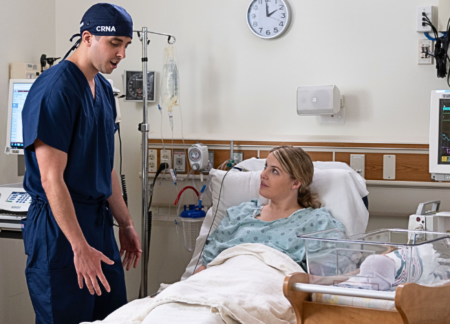
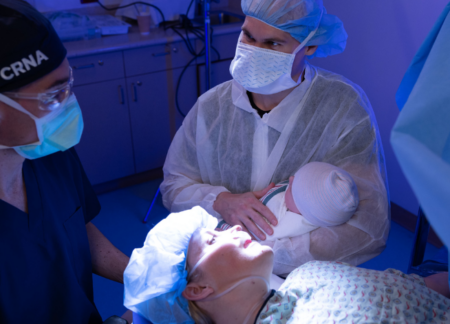
Your obstetric team will explain why a recommendation is being made and will answer your questions. Whether you’re delivering your baby vaginally or via C-section, your anesthesiaThe use of medications to temporarily block pain, sensations, and awareness during procedures and surgery. There are many different types of anesthesia that a CRNA can provide. professional, such as a Certified Registered Nurse Anesthetist (CRNA)Sometimes called a CRNA, nurse anesthesiologist, or nurse anesthetist, these are advanced practice registered nurses (APRN) who specialize in administering anesthesia for surgical, diagnostic, and therapeutic procedures. , is there to help manage your pain, keep you and your baby safe, and provide emergency support if needed. You may also hear CRNAs called nurse anesthesiologists or nurse anesthetists. Learn more about What to Expect during a C-Section.
Disclaimer: The information on this page is for general educational and informational purposes only and does not constitute medical advice or a recommendation for any specific anesthesia technique, drug, or treatment. Users should consult a qualified medical professional before making any decisions regarding anesthesia care. For complete terms, see our Terms of Use.






Was this helpful?